
Make FightsATW Your Preferred Combat Sports Source
Enjoy our boxing and wrestling coverage? Add Fights Around The World as a Preferred Source on Google so our latest stories can show up more often in your Top Stories.
Add FightsATW on GoogleIt was early 1986 and Stevie Cruz was becoming restless with his boxing career. The former amateur star – he was a Junior Olympic, Texas and National Golden Gloves champion – had only lost one of 26 fights as a professional, but the momentum had slowed.
It felt like the boxing world had forgotten about him.
Yet he continued to train with fervor. The latest in a long line of fighting Cruzes, his father, Esteban, would motivate his son with impromptu film sessions. And his Uncle Joe would follow him during roadwork sessions, nudging him with the car if he dared slow down. There was no big fight scheduled – but he continued to work as though he was about to get the opportunity of a lifetime.
Then the opportunity of a lifetime landed in his lap.
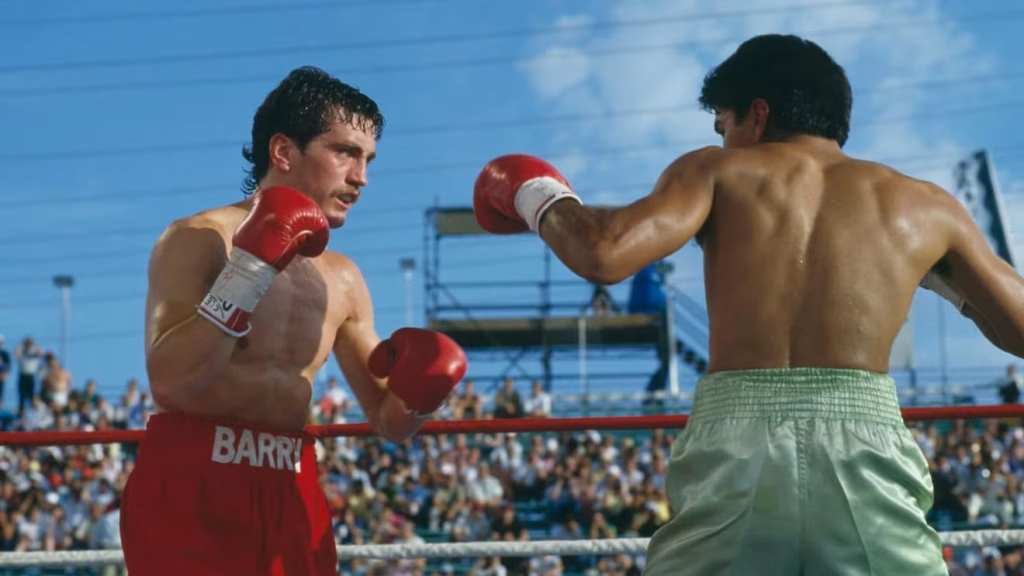
Cruz was offered a shot at WBA featherweight champion and Irish sensation Barry McGuigan on June 23, 1986, in the outdoor arena at Caesars Palace. It didn’t matter that he had only three weeks to prepare for McGuigan, arguably the biggest star in boxing, or that he’d be appearing on a huge show that also included Roberto Duran and Thomas Hearns. He was singularly focused on the dream he’d had since his grandfather bought him his first pair of boxing gloves at age five – winning a world championship.
It’s been 40 years since Stevie Cruz, a substitute for injured Argentine contender Fernando Sosa, overcame 9-1 odds and shocked McGuigan via 15-round unanimous decision to win the WBA’s featherweight crown in one of the biggest upsets in modern boxing history. The torrid fight, waged in unforgiving 110-degree heat (some say the thermometer read as high as 125 at the opening bell), was named “The Ring” magazine’s 1986 “Fight of the Year,” and would’ve been named the “Upset of the Year” had Cruz’s stablemate, Fort Worth’s Donald Curry, not lost to Britain’s Lloyd Honeyghan later that year.
Down on two of the three judges’ scorecards entering the 15th and final round, Cruz dramatically dropped a brave but exhausted McGuigan twice in that final frame to pull ahead for good. It was a scenario that almost nobody expected. Over the previous year, the swarming, hard-punching McGuigan had taken the U.K. by storm in winning the title from Panama’s longtime champ Eusebio Pedroza in London and defending his title in Belfast and Dublin. Over the course of his five-year career, the native of Clones, Ireland, had also become a symbol of unified peace among warring Catholic and Protestant supporters. Instead of wearing green or orange, which represented one of the two sides, McGuigan wore a white flag of peace on his trunks. His father, Pat, would sing a moving rendition of “Danny Boy” before his fights.
“Leave the Fighting to McGuigan” was the battle cry. He was a national hero.
His team, eager to capitalize on the charismatic McGuigan’s immense popularity at home, knew that his exciting style and boyish charm would play well in America. So the Caesars card was billed as his official coming-out party in the United States.
American media celebrated the personable Irishman’s forthcoming arrival with magazine covers, full-length stories, and animated hoopla. It was to be the first stop in the “Clones Cyclone’s” conquering of America.

But Cruz’s unlikely heroics changed the course of boxing history. Four decades later, the huge win still resonates.
“Oh, he’s a legend in Fort Worth,” said Texas boxing coordinator Lester Bedford, who promoted Cruz over the early portion of his career. “Steve Cruz is one of the best fighters in the history of the State of Texas.”
Born in Fort Worth almost three weeks before President John F. Kennedy’s assassination in neighboring Dallas on November 2, 1963, Cruz was meant to be a fighter. His grandfather, Jose, had been a fighter. His father had been a fighter. And his uncle had been a fighter. And so, it made sense that Stevie would be a fighter too. But it wasn’t just boxing that drew Cruz in.
“There was something about sports that I liked,” he said. “My Uncle Joe was a boxer first, and he was a football coach too. He got me into pee-wee football, so half the season I’d box and half the season I’d play football. And then I started preferring boxing because I won the Junior Olympics and the National Junior Olympics and the National Golden Gloves and got to travel for the USA Boxing Teams as an amateur. So all that stuff pumped me up and motivated me. I liked winning.”
The payoff for all that amateur success was to be the 1980 Olympics in Moscow. But when the Soviet Union invaded Afghanistan, the United States boycotted the Summer Games and Cruz’s Olympic dream was suddenly over before it began. He thought about waiting four more years for a chance at the ’84 Games in Los Angeles, but was eager to turn pro.

“I was disappointed,” Cruz said. “I told my dad, ‘Dang, I’m going to have to wait another four years? I don’t think so. I think I’ll turn pro.’ My dad was against it. But I was 18 by that time, so he said ‘ok.”
So, after amassing a record of 250-20 as an amateur, Cruz turned pro on October 29, 1981, under the tutelage of Dave Gorman, who also trained Fort Worth world champs Curry and Gene Hatcher in the early 1980s.
Bedford, who oversaw many of Texas’ biggest fights in the late 1990s and 2000s and is the founder of the Texas Boxing Hall of Fame, promoted Cruz’s first several fights.
“He was a beautiful fighter,” he said. “From a technique standpoint, he was basically flawless. His hands were perfect, and he had great hand speed and was very methodical. He had everything.”
Cruz rolled off 19 straight wins (10 by KO) and was riding high when he ran into puncher Lenny Valdez in 1984. He was taken out in less than a round, and all the momentum came to a screeching halt after the unexpected result. It sent Cruz back to the drawing board.
“Steve just walked into a big punch that night,” Gorman said at the time.
Cruz returned to his winning ways, reeling off six more wins, including a decision over former title challenger Rocky Garcia in February 1986. But the buzz of his early career had subsided. The Valdez knockout had made him invisible.
But even through all the uncertainty, his father urged him to continue training. He motivated his son with his famous pep talks and implored him to be ready, because you never knew when the call would come. So Cruz pushed through the unforgiving Fort Worth heat, doing his road work under the blazing Texas sun. Even morning work as a plumber’s apprentice offered little relief from the high temperatures, as most of the job was conducted outside.
“My dad always told me that if you want to be a world champion, you have to sacrifice,” Cruz said.
It can be argued that the ring on that June 1986 day when Cruz challenged McGuigan in the Las Vegas desert was one of the hottest boxing matches ever fought. And ultimately, it favored the Texan who was used to the sun beating down on him. But it was McGuigan’s camp that insisted on the early start to accommodate his fans back home in Ireland so that they could watch the fight at a decent hour.
“I had a discussion about where the fights should happen on the program because some people said the (McGuigan-Cruz fight) should be the main event while other people said no,” said Top Rank Boxing’s Bob Arum, the Hall of Fame promoter who oversaw the now-famous “Triple Hitter” card. “Then Barney Eastwood, the manager of McGuigan, shocked everybody when he said it should be the first fight on the telecast. We asked why. He said, ‘Well, because it’ll be on English television at a better time. And if you pushed it back and it was on television later, it would be on in the early hours of the morning.’”

So McGuigan and Cruz were to step into the ring at 6:20 p.m. Pacific Time – preceding the Duran-Robbie Sims and Hearns-Mark Medal fights. The temperature at ringside was expected to be well into the triple digits.
“I found out when I got there. I didn’t know we were going to be fighting in the heat like that,” Cruz said.
It was a stifling heat that was made worse by the blazing ring lights.
“Someone could’ve died in the ring that day,” Bedford said.
Elements aside, Cruz’s approach required a concentration as intense as the heat.
“The strategy was to stick and move and stay away from his power because I knew he had it,” he said. “I had to box him and stick to my gameplan. Don’t try to slug it out with him because I may get hurt.”
And so the fight started, with McGuigan pressing and Cruz boxing and countering. It was fast-paced from the outset, the two finely conditioned featherweights banging away as though they were in an air-conditioned indoor arena. The early rounds were marked by fierce exchanges, the fighters pounding each other as the sun pounded them – their long shadows being cast poetically on the blue canvas and celebrities such as Redd Foxx shielding their eyes from the glare.
As the sun began to dip, the battle waged on, with both fighters having their moments but neither gaining a distinct advantage. They were locked in a firefight in a fire pit, a violent dance with Cruz in his traditional light green playing the matador to McGuigan’s red-attired bull amid a colorful, boisterous backdrop.
But as the fight entered the late rounds, it was the champion who began to falter. Cruz dropped McGuigan with a short counter left in the 10th round. It was a stunning moment that momentarily silenced McGuigan’s legion of vocal fans who made the trip from Ireland. The titlist was up and ready to fight – but it served as a precursor to the drama that was to come.
Later, in the 12th, McGuigan was docked a point by referee Richard Steele for a low blow. More evidence that the plucky Irishman was fading and that those long runs in the Texas heat were paying off for Cruz.
McGuigan rallied in the 13th and 14th rounds, gaining two-point advantages on two of the three judges’ scorecards. Heading into the final round, it was his fight to lose.
“I wasn’t sure what the scores were, but my dad always said, ’ Don’t take anything for granted,” Cruz said. “He told me when I was coming up: ‘always finish the fight strong.’ Being this was the last round of a title fight, I gave it everything I had. You never know what the judges are thinking. So I just let it go. When I picture it in my head, I picture me slugging it out like the Little Rascals throwing windmill punches until the bell rings.”
Cruz dropped a sun-beaten McGuigan onto the seat of his velvet trunks with 1:22 to go in the fight. The crowd erupted. McGuigan wore an exhausted half-smile as he rose to his feet. Cruz resumed the attack and unleashed combinations, backing McGuigan into the ropes with Gorman waving him forward – knocking him down a third time with about 30 seconds to go. McGuigan was up quickly, but his legs were wobbly and he clinched hard to the dismay of the fans as the clock wound down to the end of the fight.
With that, it was obvious that Cruz had sealed it with his final round rally. He jumped into the arms of his trainers Gorman, Joe Barrientes and Henry Mendez and stablemates Curry and Troy Dorsey. Ring announcer Michael Buffer’s announcement that Cruz was the winner was a dramatic formality – one the Fort Worth fighter waited his whole life to hear.
“And the winner….from the great state of Texas….”
The sweat-soaked crowd of 10,500 exploded.
“When it was over, it was like a relief – like ‘whew,’ it’s over,” said Cruz, who was 22 years old. “I turned around and looked at the crowd and waved. It was a tough fight and it took a lot out of me. I was pissing blood when I went to the bathroom. I had never been through anything like that. I’d never been through anything so intense and so hot like that.”
Others may have been surprised at Cruz’s stunning win. Bedford was not.
“I was telling people I was in the room with: ‘Don’t be shocked if Cruz wins,’ he said. “I thought he could beat anybody in the world at the time. He didn’t win the National Golden Gloves by accident. He was a great fighter.”
Immediately after the fight, McGuigan said, “It was a very good fight. My timing seemed to be off. I tried all night long to recuperate and get back on track. I have no complaints. He’s a very good fighter. I couldn’t seem to hit the target. You have your off-nights.”
For Cruz and his family – life changed almost immediately.
“All of a sudden, we had to have security on him,” said Cruz’s wife, Terry. “When we went down to the casino at Caesars, they had to place security people in the elevator with us, and they started pushing people out. They wouldn’t let anyone in the elevator because people were rushing in. It was scary. It was something we had never experienced.”
Terry Cruz said they missed their flight back home because of the media crush at the Las Vegas airport. Once on the plane back to Fort Worth, there were Irish fans aboard who alerted the flight crew that Cruz was a passenger.
“The Irish people on that flight recognized him and someone ended up telling the pilot and the pilot announced Stevie as the new world champion,” she said. “The Barry McGuigan fans were rushing to get his autograph too. They treated Steve so well even though he had beaten their fighter.”
The Cruzes, who had been married for three months, celebrated a late Honeymoon in Cancun. When they returned to Fort Worth, the city threw a parade for the new champion that included the city’s North Side, the predominantly Mexican-American part of town where Cruz grew up.
“They had a big parade for him right there off Northside Drive from Downtown,” Bedford said. “There were people hanging off bridges and trees and windows. It was a pride thing. Those with lower incomes didn’t get a lot of publicity when they did things that were good. He was the Pride of the North Side.”
Cruz couldn’t believe it, calling it a full-circle moment.
“When I was a kid, I’d go with my cousins after church to the Isis Theater near the stockyards and the parade took me right by the Isis Theater,” he said. “It was amazing for me.”
But the physical toll of the fight was profound.
“The canvas was really hot, and the boxing shoes I was wearing were Adidas and they have a real thin sole,” Cruz said. “I could feel the heat from the canvas on the bottom of my feet. And afterward I had these massive blisters on the bottom of my feet. They were peeling off. And then I was sunburned. My legs were sunburned, my arms, my back. I was a mess.”
Despite his talent and the exceptional performance against McGuigan, Cruz would only be a champion for nine months. He won a non-title fight against Roger Arevalo in November 1986 before losing the title to Venezuelan slugger Antonio Esparragoza in Fort Worth in March 1987. He got two more title shots, losing to Jorge Paez via decision in 1989 and to Paul Hodkinson via third-round knockout in 1992. He went out with a win over Roberto Chala in 1993, finishing with a record of 37-8 (19 KOs).
“(Esparragoza) was a stupid fight to put him in coming off a real rugged fight like that,” Bedford said. “A young champion like that, you protect him for two or three fights and let him get a win or two. If Steve Cruz were a champion today, he’d have 15 title defenses.”
As an amateur fighter in the early 1980s, Mike Rodriguez grew up idolizing Cruz, who was four years older. He’d see Cruz at different tournaments around the country, and he loved everything about him: his humility, his style, even his hair.
“He was a cool guy and very quiet – but he was the shit back in 1981,” Rodriguez said.
Years later, he read about Cruz in boxing magazines and was excited when he beat McGuigan. Eventually, Rodriguez became a detective with the Los Angeles Sheriff’s Department. But he was always involved in boxing, first as a fighter, then as a cornerman. He has since carved out an impressive place for himself in the combat sports world. He is one of the most respected cut men in boxing and Mixed-Martial Arts. Turn on any event from either sport and you’ll probably see him.
As much acclaim as Rodriguez has received as a cornerman, he never forgot the impact that Cruz had on him as a youngster.
As a gesture of admiration, Rodriguez – the cut man for undefeated Dallas welterweight Vergil Ortiz Jr. – invited Cruz and Terry to be special guests at Ortiz’s November fight against Erickson Lubin at Dickies Arena in Fort Worth.
Rodriguez was thrilled with Cruz’s presence.
“I gave them a hug and asked the people around the arena, ‘Do you guys know who this is? This is Fort Worth’s Stevie Cruz! People were coming up to him and it was great,” Rodriguez said. “Stevie takes me back nostalgically – he’s why I love boxing and why I’ve had this connection to it since I was eight years old. Having not been able to make my mark as a fighter, the seven degrees of separation has allowed me to be around great fighters like Stevie. And for a brief moment, when I was walking back to Vergil’s locker room, I got choked up. I had tears in my eyes. Because it brought me back to a very special place.”
Terry Cruz said, “Mike contacted us and invited us to the fights; Steve is always appreciative of that. There are people that remember and appreciate him. Nineteen eighty-six. That’s a long time ago. It was before our son was born. Before our daughter was born. They only have videos of him. And now our grandchildren know their Papo was a world champ.”
Cruz looks back at the McGuigan fight with fondness. It was a great time in his life, he says. But he also says that, physically, it changed him. He noticed he puffed up easily in subsequent fights.
“My face would come out all swollen and I think that was after fighting in that heat,” he said. “My eyes were swollen shut in the non-title fight and in the title defense.
“I wasn’t the same, man.”
Now 62 years old, Cruz still works full-time – loading trucks at a Fort Worth electronics store. He has a happy, full life with Terry, his wife of 40 years; sons Stevan Anthony and Michael Joseph, daughter Stevie Rhiann and grandsons Michael Jr., 13, Mason, 11, and Maddox, 5.
But he does suspect that some of the ailments he suffers from could be side effects from the McGuigan fight – a battle waged in debilitating conditions 40 years ago.
“At different times I feel like (the ailments I have) – maybe they were leftovers from when I fought for the title,” he said.
“But I’m still kicking.”

Discover more from Fights Around The World
Subscribe to get the latest posts sent to your email.

