

The Dean Martin Celebrity Roasts belong to that category of pop culture ephemera that manages to embody all the excesses of its immediate cultural moment and yet survives the passage of time and taste to find itself a second life as a time capsule, repackaged as “vintage” or “retro.” This particular relic of the weird, wonderful 1970s survived thanks in part to a successful run of late-night VHS tape infomercial sales throughout the late 1990s. At least, that was where I first encountered the Dean Martin Roasts.
If you aren’t familiar with them, each episode featured a Man (or Woman) of the Hour, there to suffer the slings and arrows of outrageous entertainment. A dozen or so actors, comedians, politicians, authors, athletes, and other media personalities sit upon the dais, lined up like a celebrity rendition of the Last Supper, each waiting their turn at the mic. The Roasts became a Who’s Who of 70s culture, a televised pantheon of familiar names.
The format has been resurrected (I nearly wrote regurgitated) by Comedy Central and streaming services like Netflix. These new incarnations have been successful, but they lack the recurring, unifying Roastmaster figurehead that Martin provided, and I wonder if they will have the same ability to endure.
That is not to say the Dean Martin Celebrity Roasts are timeless. The comedy is distinctly of its time, particularly the racialized humor that was popular on the Las Vegas dias. Plenty of their pop culture references are lost to the fog of years, and many of the celebrity guests are no longer household names. Some have faded away. A few burnt out.
Fifty years ago today, from the Ziegfeld Room of the MGM Grand Hotel in Las Vegas, the Dean Martin Celebrity Roast honored one of its most enduring celebrities, and also the only boxer to appear as “Man of the Hour” — Muhammad Ali.
Standing at the center of the dais, Ali was quite possibly the most famous man in the world that night.
He’d won gold at the Rome Olympics in 1960. Four years later, at just 22 years old, he took the heavyweight championship by defeating Sonny Liston as an 8:1 underdog. Soon after that fight, he changed his name from Cassius Clay to Cassius X, then to Muhammad Ali, as part of his conversion to the Nation of Islam. “I am America,” he declared with defiant bravura. “I am the part you won’t recognize.”
“But get used to me. Black, confident, cocky; my name, not yours; my religion, not yours; my goals, my own; get used to me.”
The heavyweight champion soon became one of the most hotly hated men in America. After the assassination of Malcolm X, some feared Ali would be next. Over the next three years, however, he executed a string of nine audaciously stunning title defenses. Then in 1967, the undefeated Ali was stripped of his title for refusing induction into the U.S. Armed Forces. He appealed his case up to the Supreme Court, and although it took years, he won there by unanimous decision.
In 1970, he began his unparalleled, punishing comeback to the heavyweight ranks. He suffered his first loss as a pro against Joe Frazier in 1971, and barely won in their rematch three years later. As public opinion about the war in Vietnam shifted during the intervening years, the public’s perception of Ali shifted as well. In Kinshasa for 1974’s “Rumble in the Jungle,” it was George Foreman who was cast as the bad guy; Ali was the returning hero. With his crown restored, Ali then defeated Frazier in their third battle, the “Thrilla in Manila,” fourteen brutal rounds he described as “the closest thing to dying” he ever wanted to experience. That was only a few months before the Dean Martin Roast.
Ali had passed through the fire and emerged victorious. He had become an icon and inspiration worldwide, and in the United States, he was more celebrated than vilified for the first time in years.
Fifty years on, it is possible to view his 1976 appearance on the Dean Martin Celebrity Roast as the fulcrum point upon which Ali’s public persona completed its pivot from thorn in the establishment’s side to ubiquitous and lovable cultural phenomenon.
@caitlynbirkett “Unless you say so.”😂 #fyp #oldhollywood #deanmartin #muhammadali #donrickles #deanmartinroast #deanmartincelebrityroasts #legendsneverdie #roast #comedian #1970s #classic #funny #muhammad #heavyweightchamp #mrwarmth #orsonwelles #genekelly #jamesstewart #paullynde #angiedickinson
Shortly after the Roast, he recorded an album, “The Adventures of Ali and His Gang vs. Mr. Tooth Decay.” A Saturday morning cartoon show premiered the following year, as did his biopic, The Greatest, in which he played himself. His crossover comic book battle with Superman was released in 1978. He made a guest appearance on Different Strokes in 1979. Quite a change from appearing with Malcolm X and Elijah Muhammad.
In Las Vegas, the roast of Ali featured regulars including Foster Brooks, Nipsey Russell, and Ruth Buzzi. Young talent such as Billy Crystal and Freddie Prinze were there alongside veteran performers Gene Kelly and Orson Welles. From the sports world, they brought in Wilt Chamberlain and Howard Cosell, as well as boxers Rocky Graziano and former two-time Ali opponent Floyd Patterson.
The comedy style was typical of the Celebrity Roasts. Ethnic jokes were prominent, and with Ali in the hot seat, the topic of race came up frequently.
Gabe Kaplan, the star of Welcome Back Cotter, started it off by joking that his family had a history of boxers, including an uncle named Slapsy Maxie Kaplan (an allusion to a real-life boxer, the legendary “Slapsy” Maxie Rosenbloom). “You know, a lot of fighters train on steaks,” joked Kaplan. ”My uncle ate nothing but pickled herring. He couldn’t box, but he knocked out opponents with his breath.”
Martin announced the next guest, a “great white hope” named Billy “Boom Boom” Berkowitz. Boom Boom turned out to be rail-thin comedian and actor Charlie Callas, decked out in boxing togs, complete with headgear and gloves. He came to trash-talk the champ: “When they made your mouthpiece, they molded it from the Holland Tunnel.”
Then the real-life boxers came to throw some verbal jabs of their own.
Rocky Graziano, the middleweight famed for his knockout punches, mentioned the Hollywood movie based on his life, Somebody Up There Likes Me, featuring a breakout role for the young Paul Newman. “I coulda done the part,” he joked, ”but I wanted to give that Paul Newman a break.” Orson Welles got a particularly good chuckle from that one.
Then Graziano brought up Ali’s recent autobiography. “It’s real literature. To me, when they list literary men … your name will be there, with all the other great litterers.”
Floyd Patterson, a fellow Olympic gold medalist and former heavyweight champion, had been knocked out by Ali twice. But on this night, he came out swinging. Standing at the podium next to the seated Ali, he observed, “It’s good to be standing here, because whether he likes it or not, the champ has to look up to me.”
Patterson continued. “The champ always says he’s the greatest, but he never finishes that statement.” The audience laughed while Ali clowned a face of mock anger, awaiting the punchline.
“If you listen to him long enough, you can fill in the blanks yourself.”
Once Patterson was seated, Martin returned to the podium and said he’d like to invite Floyd back to his dressing room. Alluding to his drunken persona, Martin said, “I’ll show you what’s it like to have a real championship belt.”
Plenty of shots were fired at Howard Cosell throughout the night. Georgia Engel, of The Mary Tyler Moore Show, said in her quiet, naive delivery that Cosell’s ratings were so low “only the gophers were watching.”
Nipsey Russell returned to the subject of race, commenting that Cosell “has done one thing that has made all Black people happy – he was born white!”
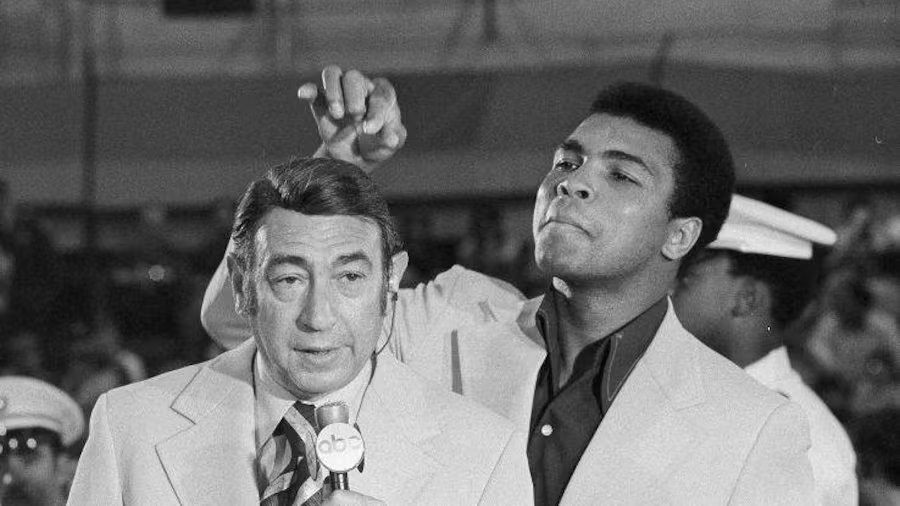
When it was Cosell’s turn at the podium, he took his requisite shots at Ali, but their deep friendship was evident. When Martin introduced Cosell as the “mighty mouth,” Ali leaned over gently and dabbed at Cosell’s lips with a napkin. At the podium, Cosell said he’d admired Ali ever since Lewiston, Maine, when Ali stopped Liston and fought “like a black panther.”
At this, Ali stood up and cried, “Don’t call me Black!”
Obviously rehearsed, Cosell pushed Ali back into his chair, adding the rejoinder, “Whatcha want me to do, call you White Tornado?” The bit ended with the two friends tussling, Ali going for Cosell’s famous hairpiece.
The Dean Martin Celebrity Roasts mostly played to the audience’s expectations. If there was any surprise that night, it was the newcomer, Billy Crystal.
In 1976, he was a relatively unknown (but promising) stand-up comedian. His agent knew he could deliver spot-on impressions of both Cosell and Ali. The Celebrity Roast was the perfect opportunity to showcase Crystal’s talent before a national audience.
Introduced by Martin as a reporter for the Louisville Courier, he launched directly into a bit featuring his impression of Cosell covering the recent “Thrilla in Manila” between Ali and Frazier. Plenty of people could do a decent Cosell impression, but few had the skill – or the nerve – to do Ali. That night, Crystal nailed it.
“I’m so fast,” he said, perfectly mimicking Ali’s blend of braggadocio and Louisville drawl, “I can turn out the lights and be in the bed before the room gets dark.” Afterwards, Crystal and Ali struck up an unusual and lifelong friendship. Ali appreciated his humor, and Crystal admired his strength.
When Ali died in 2016, the entire world grieved.
At the funeral, Crystal was invited to eulogize his friend. He told stories. He told jokes. The audience, including Ali’s immediate family, laughed and cried along with him.
He shared a memory that spoke to Ali’s compassion and deep sense of justice. Training for a fight, Ali went running at a golf course every morning. When he invited Crystal to join him for a run, he had to decline because the country club was closed to Jewish people. Ali had not known this rule. Disgusted, he vowed never run there again. “And he didn’t,” said Crystal
Crystal made the observation that there was a quality in Ali that was bigger than any one man. “It’s very hard to describe how much he meant to me; you had to live in his time,” Crystal said.
“It’s great to look at clips, and it’s amazing to have them, but to live in his time, watching his fights, experiencing the genius of his talent, was absolutely extraordinary.”
It’s been fifty years since Ali was honored as Man of the Hour, and almost ten years since he passed. Just a month ago, the USPS honored him with a stamp. Although we are no longer living in his time, millions worldwide continue to be inspired by his selflessness, his courage, and his unwillingness to back down from a fight – in and out of the ring.

Beyond his role as a world-class athlete, Ali refused to be silent in the face of injustice. He stood up against discrimination wherever he encountered it, from the military induction center to the golf course. Where would he stand today, in the face of growing wealth inequality that grinds millions into poverty? Of racial terror inflicted under the guise of immigration policy? Of the saber-rattling of colonial military force?
We are living in our time. It is our turn to speak out on the injustices of today, as he did. Let our voices be the enduring legacy of The People’s Champion, the Louisville Lip, The Greatest.

Discover more from Fights Around The World
Subscribe to get the latest posts sent to your email.

