

As the book officially closed on 2025 (Happy New Year from the FightsATW fam) and we begin looking forward to the upcoming year, it must be acknowledged that 2026 is primed to be one of the biggest years in the history of the wrestling industry. In fact, you would have to travel back 27 years to the last time that three separate wrestling promotions were televised on three distinct networks.
At that moment in wrestling lore, WWF/E, WCW, and ECW had secured national time slots on USA, TNT/TBS, and TNN, respectively, until the early 00’s, when the ‘leader in sports entertainment’ absorbed both entities.
Today, WWE is enjoying the best business it has ever managed while both ESPN and Netflix work to usher in a grander vision for the company than even Vince McMahon could have imagined. All of this as companies like AEW and TNA navigate their own broadcasting deals, AEW entering the second year of their multi-year, multi-platform deal with Warner Bros Discovery (WBD), and TNA officially launching on AMC/AMC+ Thursday, January 15.
Yes, that means 2026 will begin a Monday-Saturday TV schedule for every major wrestling promotion on TV, including NXT on the CW every Tuesday—it is a lot of wrestling, no matter how you swing it.
The business is still enjoying the early 2020’s boom that saw a resurgence in casual wrestling viewership and online interest, but unlike past booms, the rewards are being reaped by more than a single ‘Titan-like’ company.
With wrestling enjoying a wider spotlight, it is important to reflect on where improvements can be made and what adjustments can be made to fully capitalize on this opportunity. That is why the new year is the perfect time for ‘resolutions,’ little intentions we set to be a better, happier version of the us we were last year.
The following list is a set of resolutions (“Wresolutions,” if you will) intended to offer up ways that wrestling can learn from the blunders and missteps of yesterday, free from judgment or blame. This is NOT meant to be a practice in wrestling politics, nor is it intended to be biased in favor of or against any one promotion.
ALL GOLD EVERYTHING? (too many belts)
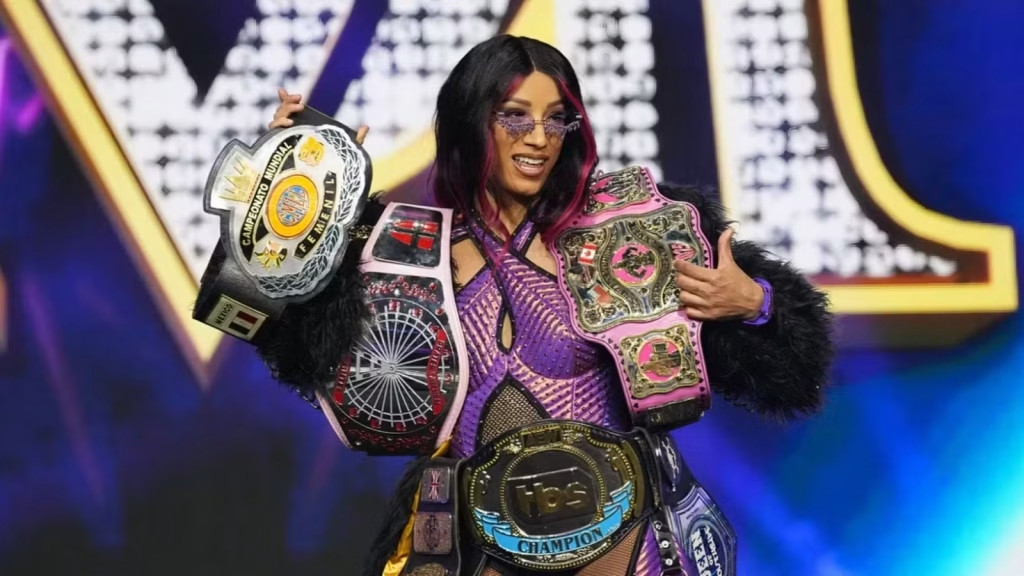
The blame thrown at one promotion or the other for excessive belts is hilariously hypocritical, since every major promotion, for the most part, is guilty of having too many championship belts. Equality is important in wrestling, and there should be similar opportunities for the women’s division to compete for the various types of titles that the men routinely vie for, but it is impossible to differentiate titles from one another when they compete on the same show under the same premises. Instead of several mid-card belts, let’s get back to belts that represent the best of a particular division.
The golden era, as it went, proceeded by having a single title for every division, with distinct rules and parameters for winning/defending.
- World Title/Heavyweight
- Mid-Card belt like Intercontinental or U.S.
- Cruiserweight/Light Heavyweight
- Tag Team
And then there were the structural titles, such as ‘hardcore championships’ meant to be defended 24 hours a day, 7 days a week (even off TV), or the TV title that had to be defended in every TV episode, which helped add variety to the weekly programming.
It might be too late for some, but, for GOLD’S sake, beat it with the belts already.
RETIRE THE RETIREMENTS ALREADY (NO MORE ‘retirement runs’)

2025 marked a unique attempt at the ‘year-long’ retirement angle. In wrestling, retirements are typically woven into the storyline, but for the GOAT, it was only fair that he go on tour for a final run. Aside from this bold first attempt at honoring a superstar wrestler in the fashion of an NBA or MLB superstar, John Cena did a lot of things for the first time—winning a record 17 world championships and turning heel among the most notable.
Now, with AJ Styles likely making 2026 his swan song, it appears that this trend is staying ‘viral.’ There is nothing wrong with celebrating the sport’s most memorable superstars lavishly, and some with careers so big that a full year’s worth of work seems only fitting.
That said, the amount of unfair pressure placed on John, his segments, and the talent working with him created unrealistic expectations. Years from now, we might have kinder criticism of the final Cena year, but the weight of each booking made for moments impossible to live up to.
That is not to take away from those clearly responsible for dampening his last run—The Rock and Travis Scott, in particular, but if we can learn anything from this, it’s that ‘scarcity’ is a powerful economic device while simultaneously existing as a potentially treacherous promotional tool.
STREAMED OUT (number of different streaming platforms)

At 12 am ET on Wednesday night, U.S. Netflix subscribers received access to the vast WWE PLE/PPV library, including WrestleMania. RAW is also included, except for some early 2000’s episodes. Before this transition, Peacock was the home of the WWE library in U.S. markets, but WWE has since moved a majority of its content off the platform.
Yet, you must still have Peacock if you want to watch NXT PLEs and Saturday Night’s Main Event, and that does not include the need for ESPN’s app or a corresponding cable subscription for live PLEs. With NXT on the CW/CW app, that makes four different platforms for which a WWE fan must subscribe to enjoy the full product.
AEW and TNA are both on cable, so you do not need the apps to watch, though it remains an option to watch on HBO MAX or AMC+. Still, a full-fledged wrestling fan is being stretched thin, and we miss the WWE Network more and more each day.
PRICED OFF! FANS OR FAMS? (cost of ticket prices)

Okay, this might be a little more politically charged, singling out WWE, but the general point is for all companies.
That said, we must address the crux of this issue: specifically, what Mark Shapiro, the president and COO of TKO, said about ticket pricing. The comment has been misrepresented many times, but the message was clear, and though he never slighted McMahon, he was critical of his ” family-friendly ” (affordable) ticket pricing.
Since capitalist techniques were implemented in the TKO regime, fans, media, and wrestlers alike have openly criticized the company for its crazy price hikes. In fact, a video surfaced of Randy Orton openly apologizing to fans after learning what they spent on WrestleMania tickets.
Now, the cost of Mania tickets can be understood in the same way Super Bowl tickets are significantly higher than regular-season tickets; the problem is that the WWE has raised ‘regular season’ too. The idea of WWE treating employees and fans like a ‘family’ feels beyond us in the current landscape, and they should reflect on what that means and whether that is the message they want to convey. ‘Maximizing profits’ is TKO’s job, and reestablishing ticket prices to better represent your perceived market value is a comprehensible practice.
Unfortunately, they do not offer courses on predicting wrestling trends in business school, and some of TKO’s brightest MBAs might just drive the larger viewing audience into the arms of the affordable competition.
FLY SLOTTING THE COMP (the counter-programming problem)

Again, this might seem specifically critical towards one company, but heavy is the crown, and in this case, WWE is the primary driver of this practice. To be clear, there are other ways to counterprogram, and AEW showed as much by using Blood and Guts ahead of War Games this year.
So, to be specific, this is a condemnation of the practice in its entirety, but WWE paid the price for it this year. AEW moved times around and showed they can do big business working around unique start times, while NXT flopped when it attempted to go head-to-head with AEW—PLE VS PPV.
Bottom line, the strategy did not have the intended effect, and that alone would be a good enough reason to refrain from intentionally countering the competition. That said, no fan should be okay with this because it only dilutes the content. As consumers, we should have options and be grateful that we can see a polished production at the highest level on one hand and high-action quality sports-based wrestling on the other.
Competition breeds quality, and fans will remember the ‘Monday Night Wars’ as one of the most interesting eras in wrestling, with two companies delivering must-see TV consistently. I contend that diverse programming options will have a direct impact on the quality of content that we get from the top on down, while providing opportunities for more talent.

Discover more from Fights Around The World
Subscribe to get the latest posts sent to your email.

